

Let's talk about
Glass,
Plastic,
Microplastics and
talk about the "perfect" bottle.
We used glass for years ourselves. Then we took a closer look.
When we started Kombuchery, glass was the obvious choice for us: glass felt right. Reusable sounded sensible. We wanted to avoid plastic as much as possible.
Unfortunately, like many new beverage brands, we had the problem that we weren't available everywhere in retail, so our reusable bottles couldn't be returned everywhere either. This understandably annoyed and disappointed many customers. At the same time, there were very important retail chains for us that could not include deposit glass bottles in their product range.
Therefore, we had to take a closer look at our packaging and bottling and came across studies by ÖKO-TEST on microplastics in beverages. The results surprised us.
Because they showed something that contradicted our previous understanding:
Glass doesn't automatically mean less microplastic, and plastic is not all the same.
Since then, we no longer simply look at the material of a bottle.
Key facts at a glance:
- Glass does not automatically mean less microplastic. Studies found microplastics in both glass and PET bottles – some individual glass samples were significantly higher than PET.
- It's not just the material that matters. Cleaning, refilling, closures, labels, and other production steps can also be potential entry points.
- Not all PET is the same. In scientific studies, single-use PET showed significantly lower microplastic contamination than reusable PET.
- PET is manufactured without BPA and classic plasticizers. According to current knowledge, the German Federal Institute for Risk Assessment sees no evidence of a health risk from PET bottles.
- That's why today we use 100% recycled PET. Our bottle is around 90% lighter than our previous glass bottle and is returned via the German single-use deposit system.

Let's start at the very beginning...
...because the bottle is only one part of a long chain.
When we talk about plastic in beverages, we usually look at the packaging first. But a drink starts long before the bottle.
For us, it begins with the most important ingredient of our kombucha: natural mineral water from an Alpine spring, followed by high-quality ingredients from 100% organic farming.
Especially with kombucha, water is far more than just an ingredient. It makes up the largest part of the drink, forms the basis for our tea, and thus for the subsequent weeks of fermentation. Its quality is therefore crucial for us from the very beginning.
"Natural mineral water" is a legally protected term. It comes from an underground water source protected from contamination, must be of original purity, and is officially recognized.
This is precisely why we deliberately chose to produce our kombucha at an Alpine spring, instead of, for example, simply having it bottled in Berlin.
Thus, our commitment to quality doesn't just begin with organic ingredients, fermentation, or packaging, but already with what makes up the largest part of every bottle: the water.
And only after that does the journey through production, bottling, and packaging begin.
What happens on the way to the bottle?
After water and ingredients, there are tanks, hoses, pumps, valves, seals, filters, filling systems, and closures, and only at the very end, the bottle.
What is quickly overlooked here: Many of these product-contacting components consist entirely or partially of plastics or polymeric materials.
And this applies regardless of which packaging is ultimately chosen. Even glass closures can contain plastic seals or coatings. Aluminum or steel beverage cans typically have a thin polymer coating on the inside that separates the beverage from the metal.
That is also why the simple classification "glass or can = without plastic, PET = with plastic" falls short for us.
But does a PET bottle therefore actually mean more microplastics in the beverage than a glass bottle?
We wanted to understand this very question more precisely.
The Study That Made Us Think
The question led us to investigate a 2021 ÖKO-TEST study. Ten mineral waters – five in glass and five in PET – were sampled and tested for microplastics. Our assumption at the time would also have been: If the the bottle is made of plastic, there should be more microplastics in the water than in glass bottles.
However, the result was not so simple.
What was particularly interesting for us was the direct comparison of two bottles from the same manufacturer:
Particles in the glass bottle
Particles in the PET bottle
The least contaminated sample of the entire set was also a PET bottle, with 10 particles.
This explicitly does not mean that PET generally contains less microplastic than glass. ÖKO-TEST also points out that the sample does not allow for a general judgment on all glass and PET bottles.
But it disproved an assumption that until then had seemed quite obvious:
Glass does not automatically mean less microplastic.
Not all "plastic" is the same "plastic"
Particularly enlightening for us was a study by Schymanski et al. published in the journal Water Research in 2018. It examined mineral water from various packaging systems, including PET disposable, PET reusable, and glass.
The result:
On average, single-use PET bottles were significantly less contaminated with microplastics than reusable PET bottles. Glass bottles also sometimes showed higher values than single-use PET.
Although single-use PET and reusable PET are made from the same basic material, the bottles undergo completely different life cycles.
For example, a reusable bottle after use is:
1. Remove labels
Labels, adhesives, and inks are removed before reuse.
2. Cleaning bottles
Reusable bottles are intensively cleaned, and studies are discussing precisely this process as a possible entry route for particles.
3. Replace closures
Every time the bottle is refilled, it is resealed. Closures, seals, or coatings can also play a role.
4. Many Orbits
The entire process repeats with each reuse, involving repeated cleaning and renewed contact with various materials.
Exactly these processes can play a role. The lead researcher explained to ÖKO-TEST:
"It is rather the bottle cleaning procedure for reusable bottles that is the contamination problem, than the mineral waters themselves."
A further study published in Water Research in 2018 by Oßmann et al. analyzed even smaller particles. Microplastic particles were also found in all tested packaging types. In reusable bottles, pigment particles were also found, the composition of which matched the printing inks used for the labels. The researchers therefore discussed, among other things, labels and the cleaning process as possible entry pathways.
This explicitly does not mean that reusable packaging is inherently bad. A well-functioning regional reusable system with short distances and many cycles can be ecologically very sensible.
However, when it comes to microplastics, the studies show:
It's not just the material that matters.
It's the entire lifecycle of a package.
Precisely for this reason, when making our packaging decisions, we consider weight, transport, return, cleaning, recycling, and possible entry pathways together.
In 2025, another surprising finding emerged
A peer-reviewed study by Chaïb et al. published in the Journal of Food Composition and Analysis in 2025 examined various beverages and packaging types, including water, soft drinks, tea, beer, and wine.
Again, the results did not align with the simplistic notion that “glass = less microplastic”:
"Contrary to expectations, beverages from glass bottles were more contaminated with microplastics."
— own translation adapted from Chaïb et al. (2025)
More interesting, however, was the suspected source.
A large proportion of the particles found matched the color and composition of the outer coating of the metal caps of the glass bottles. The researchers also found scratches on these caps.
In further tests, the caps were cleaned and blown out with air before filling. This significantly reduced particle contamination.
For us, this study also shows:
The bottle alone doesn't tell the whole story.
Closure. Filling. Cleaning. Usage. Recycling. All these factors can play a role.

Why we now use 100% rPET
After our years with glass and our more intensive engagement with various packaging systems, we therefore stopped asking:
"Glass or plastic?"
Instead, we wanted to know:
Which packaging suits our product, our distribution channel, and a return system that actually works in practice?
Our previous reusable bottle could not be returned everywhere, and deposit-bearing glass bottles were not an option for some important retail chains.
Single-use glass was also not a sensible alternative for us: The comparatively high material and energy consumption of a glass bottle can be spread over many uses when it's reusable. With single-use glass, precisely this advantage is lost, while the high bottle weight and thus more weight to be transported remain.
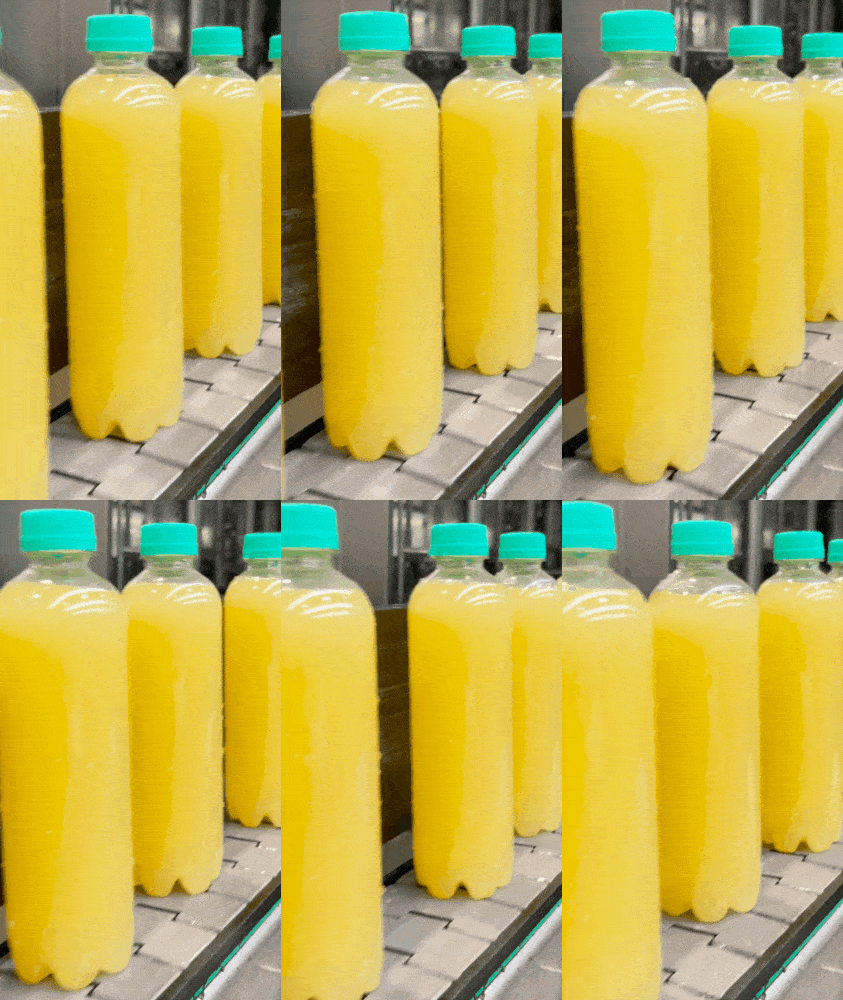
That's why today we use a single-use deposit bottle made from 100% recycled PET (rPET), which can be recycled again after return.
It is lightweight, can be returned practically anywhere via the German single-use deposit system, and does not require repeated cleaning and refilling processes for the bottle.
We have summarized the most important figures below:
from recycled PET (rPET)
lighter than our previous glass bottle
PET recycling rate
Deposit on every bottle
Kombuchery flavor
And what do the experts say about PET?
PET is plastic. There's no getting around that. But that's precisely why it's worth taking a closer look at the facts here.
The German Federal Institute for Risk Assessment (BfR) comprehensively updated its information on PET bottles in 2025. The title of the current assessment:
"PET Bottles: No Evidence of Health Risk"
In doing so, the BfR also debunks two particularly common misunderstandings.
Plasticizers are not used in the production of PET bottles
The name polyethylene terephthalate is sometimes confused with so-called phthalates, which can be used as plasticizers.
However, according to the BfR, orthophthalates and other plasticizers are not used in the production of PET bottles.
BPA is also not used in the production of PET
Bisphenol A – or BPA for short – is also not used in the production of PET bottles.
For us, this is another reason not to judge packaging based on a single buzzword.
Rather, to consider material, production, cleaning, closure, use, and recycling together.
Does the perfect packaging exist?
From our perspective: no.
A well-functioning regional returnable system with short distances and many cycles can be very beneficial. PET can release particles. Even beverages in glass bottles can contain microplastics. And during production and filling, regardless of the subsequent packaging, various materials and processes come into contact with the beverage.
That's why we don't want to sugarcoat plastic. And we don't want to disparage glass. We want to take a closer look.
At Kombuchery, we ourselves started with the simple idea: Glass feels right. Reusable sounds sensible. We want to avoid plastic as much as possible.
Today, we see things differently.
Not because glass is suddenly "bad" or PET is fundamentally "better." But because we have learned that material, production, cleaning, closure, weight, transport, return, and recycling must be considered together.
For Kombuchery, this means today:
Natural mineral water from an alpine source. Organic ingredients. Weeks of fermentation. And a lightweight, single-use, deposit bottle made from 100% recycled PET.
Not the one "perfect" packaging.
But the solution we have consciously chosen today after weighing the various factors.
And if research, technology, and circular economies enable a better solution tomorrow?
Then we will take a closer look again.
Just like we did when we switched from glass to rPET.
Does glass automatically mean less microplastic?
No. Microplastics have also been detected in beverages from glass bottles. Studies also show that caps, cleaning, and other process steps can be relevant entry pathways.
Why can reusable packaging play a role in the issue of microplastics?
Reusable bottles are repeatedly returned, cleaned, and refilled. In a study highlighted by ÖKO-TEST, PET reusable bottles were, on average, more contaminated than PET single-use bottles; some glass bottles also showed higher contamination levels than PET single-use. The researchers primarily identified the cleaning process as a potential contributing factor.
Does that mean disposable is inherently better?
No. That cannot be said across the board. That is precisely our point: material, weight, transport, cleaning, cycles, return, and recycling must be considered together.
Why don't you just use single-use glass bottles then?
Because glass can best demonstrate its strength as a reusable packaging material. A reusable glass bottle can be refilled many times. This distributes the relatively high material and energy input for the production of the bottle over many uses.
With single-use glass, this very advantage is lost: The bottle is filled only once and then melted down and recycled. At the same time, it remains significantly heavier than a PET bottle and therefore also causes significantly more weight to be moved during transport.
For our nationwide distribution, single-use glass would therefore not be a convincing alternative: We would take on a significant disadvantage of glass – its heavy weight – without utilizing its decisive reusable advantage.
Our current rPET bottle is approximately 90% lighter than our former glass bottle, consists of 100% recycled PET in the bottle body, and can be returned to recycling via the single-use deposit system.
Therefore, the relevant decision for us was not "single-use PET or single-use glass?", but rather: If our glass reusable system does not work reliably in our distribution model, which single-use system makes sense for us?
Why do you use plastic at all?
Plastics play a role in many areas of modern food production – for example, in hoses, seals, valves, and closure systems. For this reason, glass does not automatically mean a plastic-free production system. For our bottle, we use recycled PET.
Does PET contain BPA or plasticizers?
According to the Federal Institute for Risk Assessment, neither orthophthalates nor other plasticizers are used in the production of PET bottles. BPA is also not used in the production of PET.
Is rPET new plastic?
No. rPET stands for recycled PET. Our bottle is made from PET that was already in circulation and has been reprocessed for reuse as food packaging.
Sources & Further Reading:
ÖKO-TEST, July 2021 issue | Random investigation of mineral water in five glass and five PET bottles, as well as classification of scientific studies on microplastics in beverage packaging.
Schymanski, D.; Goldbeck, C.; Humpf, H.-U.; Fürst, P. (2018) | Analysis of microplastics in water by micro-Raman spectroscopy: Release of plastic particles from different packaging into mineral water | Water Research, 129, 154–162 | DOI: 10.1016/j.watres.2017.11.011
Oßmann, B. E.; Sarau, G.; Holtmannspötter, H.; Pischetsrieder, M.; Christiansen, S. H.; Dicke, W. (2018) | Small-sized microplastics and pigmented particles in bottled mineral water | Water Research, 141, 307–316 | DOI: 10.1016/j.watres.2018.05.027
Chaïb et al. (2025) | Microplastic contaminations in a set of beverages sold in France | Journal of Food Composition and Analysis, 144, 107719 | DOI: 10.1016/j.jfca.2025.107719
German Federal Institute for Risk Assessment (BfR), 28.05.2025 | PET bottles: No indications of a health risk | Current BfR assessment on PET, plasticizers, Bisphenol A, antimony, and acetaldehyde.
German Federal Institute for Risk Assessment (BfR) | Microplastics: Facts, research, and open questions | Current assessment of the scientific knowledge on microplastics in food and potential health effects.
Commission Regulation (EU) 2022/1616 | European requirements for materials and articles made of recycled plastic intended to come into contact with food.
Federal Ministry for the Environment, Nature Conservation, Nuclear Safety and Consumer Protection (BMUV), as of 22.01.2025 | What happens to used single-use bottles? | Information on the return and recycling of PET single-use beverage bottles.
German Environment Agency (2024) | Life cycle assessment of optimization potentials for beverage packaging | Current study of different beverage packaging systems and their optimization potentials.